
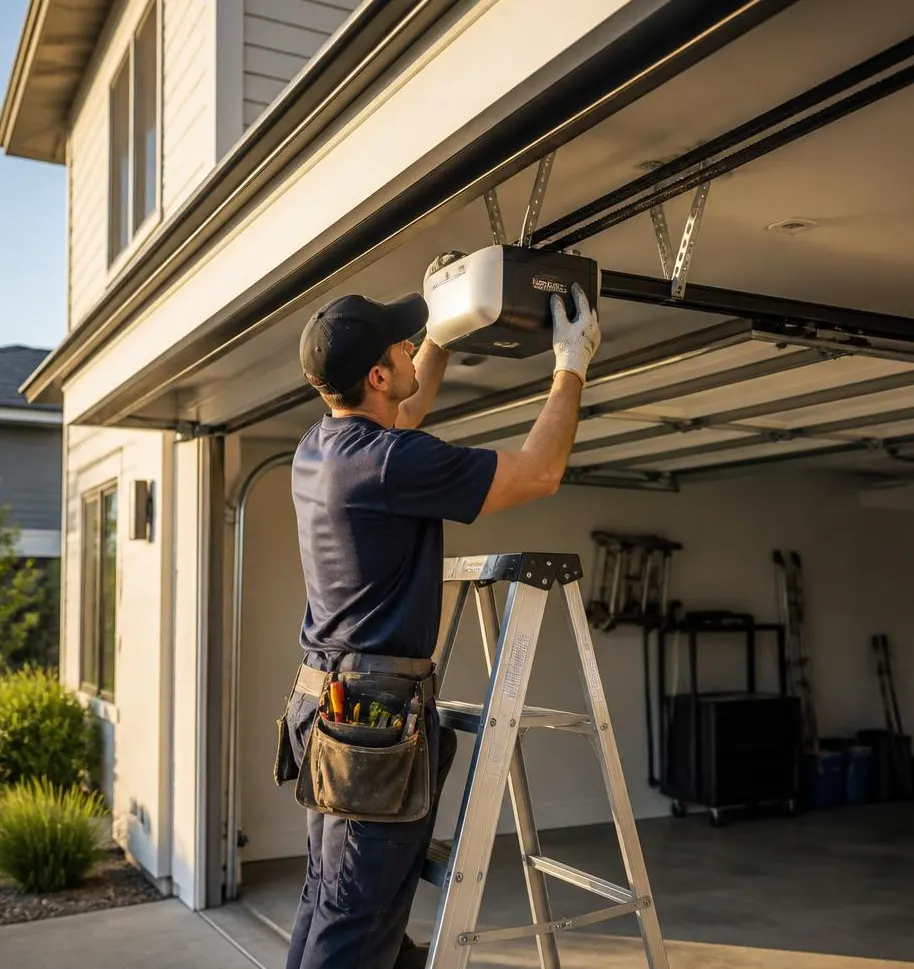
You're out in the garage on a Saturday, maybe checking that your generator still runs before the first nor'easter rolls through, and you pull the manual release cord on the garage door opener just to see how the door moves on its own. Instead of staying put, it either crashes down toward the floor or drifts upward like it's trying to escape. That's not a quirky coincidence — that's a door that's out of balance, and it's been making your opener work overtime for a while now.
An unbalanced garage door is one of the most common problems in older homes around Royersford, Collegeville, and Phoenixville, where original doors and springs have been through years of freeze-thaw cycles, salty winter air, and humid summers. The good news is that testing for balance takes ten minutes and almost no tools. Here's how to do it, and where the line sits between what you can safely check yourself and what needs a technician.
What "Balance" Actually Means
A properly balanced garage door is one where the springs — not the opener — are doing the work of holding the door's weight. The opener's motor is only supposed to provide the small amount of force needed to move the door along the track once the springs have counteracted gravity. When a door is out of balance, the motor has to make up the difference, lifting weight it was never designed to carry.
Tools You'll Need
- A step stool or short ladder (if your release cord is out of easy reach)
- Work gloves
- A flashlight
- A pencil and a notepad or your phone, to mark and record where the door stops
That's it. No wrenches, no winding bars, nothing that touches the springs themselves.
How to Test Garage Door Balance, Step by Step
- Close the door completely. Start from a fully closed position so you're testing the whole range of travel.
- Locate the manual release cord hanging from the trolley on the opener's rail, usually a red handle.
- Pull the release cord to disconnect the door from the opener. You should hear a click, and the trolley will separate from the carriage. The door is now running on spring tension alone.
- Lift the door by hand to roughly waist or chest height — about three to four feet off the ground.
- Let go and watch what happens. A well-balanced door will stay almost exactly where you left it, maybe drifting down an inch or two. A door that slams shut, drops several feet, or shoots upward is telling you the springs are no longer matched to the door's weight.
- Repeat the test at two or three other points along the door's travel — near the top, near the bottom — since a door can be balanced in one spot and off in another, especially on older sectional doors with uneven panel wear.
- Write down what you see at each point. This matters if you end up calling a technician, since it helps pinpoint whether one spring has weakened more than the other or whether the whole system has drifted.
- Reconnect the opener by pulling the release cord again (or following your opener's reconnect procedure) and running the door through a full open-close cycle to make sure the trolley has properly re-engaged.
What an Unbalanced Door Does to Your Opener
This is the part most homeowners don't think about until the opener fails outright. A garage door opener motor, drive gear, and circuit board are sized for light-duty work: moving a balanced door along a track. When the springs stop pulling their weight, the opener has to:
- Draw more current every cycle, which heats up the motor and shortens its lifespan
- Put extra strain on the drive gear or belt, leading to stripped gears or a snapped belt sooner than expected
- Struggle to hold the door at the set open or closed position, which can throw off the opener's travel limits and force-sensing settings
- Pull harder on the mounting bracket where the rail meets the header above the door, sometimes loosening it over time
In cold weather, this gets worse. Steel springs lose a bit of tension as temperatures drop, lubricant inside the opener's gearbox thickens, and a door that was marginally balanced in September can become noticeably unbalanced by January. Combine that with ice buildup on the track or weatherstripping, and the opener is fighting on multiple fronts at once — which is exactly when people hear a new grinding noise or notice the opener light flashing error codes.
What You Can Check, and What Needs a Technician
The balance test above, along with a visual check of the springs for visible gaps, rust, or stretching, and listening for grinding during the lift, is all safe homeware territory. What is not a DIY job is adjusting spring tension. Torsion springs are wound under extreme force, and adjusting or replacing them without the right winding bars and experience is a genuine injury risk — this is true whether you have a newer door or one of the original doors still common in Montgomery County's older housing stock. Track alignment issues, worn cable drums, and bent header brackets also fall into technician territory, since small adjustments in the wrong direction can make an unbalanced door worse.
When to Call Royersford Garage Door
If your door fails the halfway test, or you've noticed the opener straining, running hotter, or making a new grinding sound, it's time to call. A technician from Royersford Garage Door will re-run the balance test with calibrated tools, inspect both springs and cables for wear from salt and moisture exposure, and recommend either a Spring Replacement or a full Garage Door Maintenance visit depending on what they find. Catching an imbalance before winter means your opener isn't fighting the cold and the springs at the same time — and it means you're not the one stuck troubleshooting a dead opener during the next nor'easter.
If you're in Royersford, Collegeville, Limerick, Trappe, Phoenixville, Spring City, Pottstown, or Schwenksville and your garage door failed its balance test, give Royersford Garage Door a call before the first hard freeze settles in.