
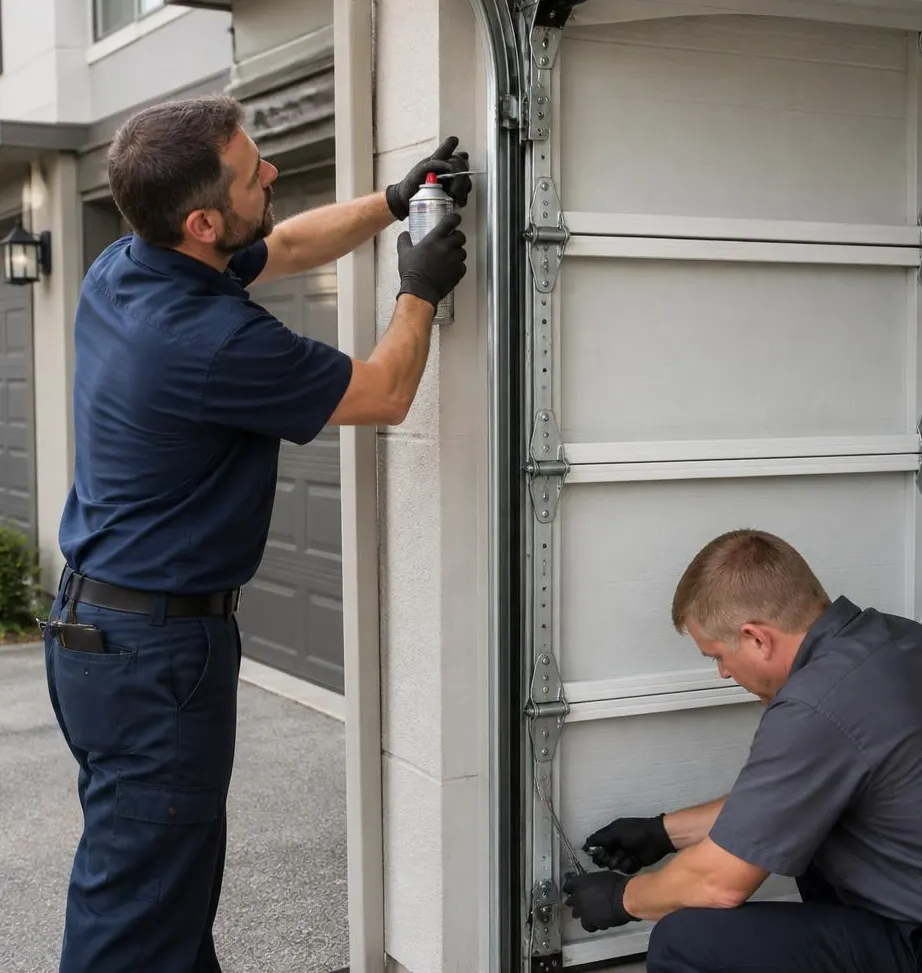
What a technician usually finds on this kind of call
The call usually starts the same way: "It's making a weird noise and I don't know if it's dangerous." A technician shows up, raises the door by hand, and within thirty seconds spots one of two things. Either there's a cable at the bottom corner with a few strands sticking out like a frayed shoelace, rusted where it wraps the drum — or the rollers are cracked, flat on one side, or worn down to bare metal where the plastic coating used to be. Both are quiet failures. They don't announce themselves the way a snapped spring does. They just get a little worse every week until the door jerks, drags, or comes off track entirely.
Cables and rollers aren't the same problem
It's worth settling this part first, because it changes what's safe to do yourself. The cables are steel lines connected to the springs, and they carry the full tension that lifts your door. The rollers are the small wheels, usually nylon or steel, that ride in the vertical track and let the door glide up and down smoothly. One is a tension component. The other is a guidance component. A frayed cable is a structural problem — it can snap under load. A worn roller is a wear-and-tear problem — it gets noisy and rough, but it doesn't typically fail violently.
What frayed cables look like and sound like
- Visible broken strands near the bottom bracket, often with rust where the cable has been rubbing
- A door that hangs crooked, with one side noticeably lower than the other
- A sharp popping sound as the door moves, especially near the top or bottom of travel
- The door jerking to one side instead of moving in a straight line
A frayed cable is still under tension from the spring system, even when the door looks fine at rest. That tension is exactly why this isn't a DIY repair — a cable that lets go while under load can whip hard enough to cause real injury or damage. If you see fraying, the safest move is to leave the door down, avoid using the opener, and get it looked at.
What worn rollers look like and sound like
- A grinding or squealing sound as the door travels through the track
- Visible flat spots, cracks, or chunks missing from the roller wheel
- The door wobbling side to side or seeming to "jump" slightly as it moves
- Rollers that look shiny or metallic where the outer coating has worn away
Worn rollers are more of a comfort-and-longevity issue than a safety emergency, at least at first. But they put uneven strain on the track and hinges, and a roller that finally gives out can let the door jump the track, which turns a cheap fix into a bigger one.
Why these parts wear out faster around here
Local conditions do real damage to both. Winters bring repeated freeze-thaw cycles, plus road salt that gets tracked into garages and kicked up as spray, and that salt accelerates rust on exposed steel cables far faster than in a dry climate. Humid summers don't help either — moisture sits on hardware and speeds up corrosion in the gaps between uses. And a lot of the housing stock in this area still has original garage doors, which means rollers and cables that have never been replaced are often 15, 20, even 30 years into service life that was only ever rated for 10 to 15 years of regular cycling.
What you can safely check yourself
With the door closed and the opener unplugged, take a flashlight and look at the cables near the bottom corners — you're checking for fraying, rust, or kinks, not touching anything. Separately, with the door open, look at the rollers in the track for cracks or flat spots. If they're just dirty or dry, a garage-door-specific lubricant (not WD-40, which attracts grit) on the roller stems and hinges can quiet things down temporarily. What you shouldn't do is loosen cable fasteners, adjust anything near the spring, or try to replace a cable yourself — that work has to be done with the door safely secured and the spring tension controlled.
When to call Royersford Garage Door
If you've spotted frayed strands on a cable, don't run the door — call before it fails on its own. If it's rollers that are grinding, cracked, or causing the door to wobble, that's a good candidate for our Garage Door Repair service, where we'll replace the worn rollers and check the track and hinges while we're in there. For doors that haven't had hardware looked at in years, our Garage Door Maintenance visit covers both — we inspect cables, rollers, springs, and the opener as a system, replace what's worn before it fails, and lubricate what just needs attention. Cables get replaced in pairs, since if one side is worn, the other usually isn't far behind.
If you're hearing noises you can't explain or you've found fraying on a cable, give Royersford Garage Door a call. We serve Royersford, Collegeville, Limerick, Trappe, Phoenixville, Spring City, Pottstown, and Schwenksville, and we'll tell you straight whether it's a quick fix or something bigger.